If you’ve ever worked in industries like stamping, metal forming, or even high-volume plastic molding, you’ve probably heard the term “gang dies” thrown around. For those who are new to the space, gang dies—also called progressive gang dies or multi-station gang dies—are workhorses that let manufacturers produce dozens of identical parts in a single run, cutting down on labor costs, lead times, and material waste. As a supplier of single stage dies and gang dies, I talk to metal fabricators, automotive part makers, and appliance engineers every day who ask the same question: what are gang dies typically made of? It’s not a trivial question. The material of your gang die will make the difference between a die that lasts a week and one that runs for years, between parts that meet your tolerance specs every time and ones that need constant rework. I’ve spent 12 years in this business, sourcing materials for dies, testing wear rates, and troubleshooting failures in the field, so let’s break this down like I would with a new customer walking through my door. Single Stage Dies & Gang Dies

First, let’s set a quick baseline: gang dies aren’t a one-size-fits-all tool. They’re modular, multi-station dies, usually with 2 to 12 stations each, where each station performs a single operation—blanking, bending, punching, coining, forming. The materials they’re made of depend on three key factors: what part you’re stamping or forming, how many pieces you plan to run, and the tolerance you need to maintain. If you’re stamping thin 0.5mm aluminum for smartphone brackets, you don’t need the same die material as someone stamping 8mm thick carbon steel for agricultural plow blades. That’s why I always ask customers three questions before I even quote a die: material type, part volume, and required surface finish. Now, let’s get into the actual materials, starting with the most common ones, what they’re best for, and when you should (and shouldn’t) use them.
The first and most widely used material for gang dies is cold work tool steel. This is the workhorse of the die manufacturing industry, and for good reason. Cold work tool steels are alloy steels that are heat-treated to stay hard and wear-resistant even when worked at room temperature—perfect for stamping, which is done cold. There are two main grades of cold work steel that dominate gang die manufacturing: D2 and A2. Let’s start with D2, because it’s the workhorse of high-volume gang dies. D2 is a high-carbon, high-chromium tool steel, with around 12% chromium, which gives it excellent corrosion resistance and wear resistance. When properly heat-treated, it hits a hardness of 58-62 HRC (Rockwell C scale), which is hard enough to punch through most common metals—aluminum, brass, copper, mild steel, and even low-carbon stainless steel. I’ve seen D2 gang dies run 10 million+ parts without needing major rework, as long as the operator is using the right lubricant. But D2 isn’t perfect. It’s brittle, especially if it’s heat-treated incorrectly. If you’re stamping thick, high-tensile steel, or doing heavy coining operations in a gang die, D2 can crack or chip under the pressure. That’s where A2 comes in. A2 is also a cold work tool steel, but with lower carbon and chromium than D2. It’s less brittle, more tough, and easier to machine, which makes it ideal for gang dies that do a mix of punching and bending, or for parts that have complex geometries. A2 hits a hardness of 56-60 HRC, which is slightly lower than D2, but its toughness makes it less likely to fail under impact. I often recommend A2 for smaller job shops that run lower volumes (10,000 to 500,000 parts) because it’s also more forgiving during the machining process, so we can modify the die easier if the customer adjusts their part design. If you’re running a high-volume automotive parts line, though, D2 is usually the go-to because the wear resistance pays off over time.
Next up, for applications where cold work tool steel isn’t enough, we have high-speed steel (HSS). HSS is a step above cold work steel in terms of hardness and heat resistance, though it’s rarely used for entire gang dies. Instead, we use HSS for specific, high-wear stations in a gang die—usually the punching stations that go through thick or abrasive materials, or stations that run at high speeds. HSS gets up to 64-68 HRC when heat-treated, which is harder than D2 or A2, and it retains its hardness even if the die runs hot, which happens if you’re stamping very thick materials at high line speeds. The downside? HSS is way more expensive than cold work tool steel, and it’s even more brittle than D2. You’d never use HSS for the entire gang die, because it would crack under the constant bending and forming stresses. But for that one station that punches 10mm holes in 6mm thick steel, adding an HSS insert to the die will double or triple the die’s lifespan, which saves money in the long run for high-volume runs. I worked with a heavy equipment manufacturer a few years ago that was stamping 12mm thick steel for bucket hinges, and their original gang die with D2 inserts only lasted 200,000 parts before the punching stations wore out. We swapped those stations for HSS, and the die now runs 1.2 million parts before needing replacement. That’s the kind of impact material selection has.
For even more extreme applications, we have powder metallurgy (PM) tool steels. These are a relatively new class of tool steels, made by a powder metallurgy process instead of traditional smelting and casting. The process creates a much finer, more uniform grain structure in the steel, which means it’s harder, tougher, and more wear-resistant than conventional tool steels like D2 or A2. PM tool steels come in grades like PM D2, PM M4, and even higher grades like CPM 10V. CPM 10V is a popular one for gang dies that run abrasive materials, like stainless steel, aluminum with high silicon content, or even composite materials. The vanadium carbides in CPM 10V give it exceptional wear resistance—far better than D2 or HSS. It hits hardness levels of 60-64 HRC, and it’s much tougher than D2, so it doesn’t crack under impact. The tradeoff? PM tool steels are two to three times more expensive than D2, and they’re also harder to machine, so the lead time for a die made with PM tool steel is longer. But for manufacturers running high-volume parts (1 million+ annually) with abrasive materials, it’s worth the cost. Last year, we built a gang die for a company that makes solar panel frames, which are stamped from 0.8mm thick aluminum with high silicon. Their original die with D2 inserts wore out after 1.5 million parts, and switching to CPM 10V inserts let them run 5 million parts before any significant wear. For a solar manufacturer running 100,000 frames a year, that means only one die change a year instead of four, which cuts downtime costs way more than the extra cost of the tool steel.
Now, what about the backing structure of the gang die? Most people focus on the cutting and forming inserts, but the body of the die is just as important. The main body of a gang die is almost always made of carbon steel, usually 1045 or 4140 grade. These are medium-carbon steels that are easy to machine, strong enough to handle the clamping and pressing forces in a stamping press, and way cheaper than tool steel for the bulk of the die. The body is where all the stations are mounted, where the guide pins and bushings go, and where the die attaches to the press ram and bolster. You don’t need a hard, expensive tool steel for that—you need a steel that’s rigid, easy to drill and tap, and can handle the tension of thousands of pounds of pressure. I’ve seen customers try to skimp here and use a cheaper, lower-grade steel for the die body, and it leads to warping or flexing over time, which throws off the tolerance of the parts. The body might not be the part that does the cutting, but if it’s not made right, the entire gang die is useless.
There are a few niche cases where gang dies are made of other materials, though they’re not common for most applications. For example, if you’re stamping very thin, delicate parts, like electronic connectors or medical device components, sometimes we use tungsten carbide inserts for the high-wear stations. Tungsten carbide is an extremely hard material, up to 90 HRA (Rockwell A scale, which is a different scale for very hard materials), way harder than any tool steel. It’s wear-resistant, dimensionally stable, and perfect for thin materials that need tight tolerances. But it’s super brittle, and it’s very expensive—like, 10 times more expensive than D2. You only use it for small, high-wear areas in gang dies for parts that need micron-level tolerances. I’ve only installed tungsten carbide inlays a handful of times, for medical device manufacturers stamping parts that go inside the body, where even a 0.01mm deviation is unacceptable. For 99% of gang dies out there, you’ll never need to go to tungsten carbide.
Now, I want to talk about a common mistake I see customers make when choosing gang die materials. A lot of them think “harder is better.” They’ll ask for D2 or HSS for a die that’s only running 10,000 parts, and that’s overkill. Harder steels are more expensive, harder to machine, and take longer to build, so you’re paying for performance you don’t need. Conversely, some customers will try to use A2 for a high-volume die stamping thick carbon steel, and the die wears out in a few thousand parts, costing them way more in downtime and replacements than if they’d just gone with D2. The sweet spot is matching the material to your specific use case. Let’s sum that up quickly: if you’re a job shop running low to medium volumes (1,000 to 500,000 parts) of mild steel, aluminum, brass, with a mix of punching and bending, go with A2 tool steel. If you’re running high volumes (500,000+ parts) of medium to high-tensile steel, heavy coining or punching, go with D2. If you have a specific station that’s taking extra wear, add an HSS insert. If you’re running 1 million+ parts of abrasive materials, go with PM tool steel inserts. And the die body? Always use 4140 carbon steel for the best value and durability.
I also want to touch on how material choice interacts with other die factors, because it’s not isolated. For example, the surface finish of the die inserts matters too—polished inserts reduce material adhesion, which cuts wear. But even the best polished D2 insert will wear faster than a rough PM 10V insert if you’re stamping high-silicon aluminum. Lubrication also plays a role; using a high-quality stamping lubricant reduces friction and wear, so you can sometimes use a slightly lower grade of tool steel and still get the same die lifespan. But material is still the foundation.
As a supplier of single stage dies and gang dies, my job isn’t just to sell you a die—it’s to sell you a die that works for your business. I’ve seen too many customers buy a cheap die made with the wrong material, only to regret it when downtime eats into their profits. Last year, a small appliance maker came to me after buying a gang die from a different supplier for stamping 2mm thick steel for washer brackets. The supplier had told them the die was made of “heavy-duty tool steel,” but it was actually made of low-grade carbon tool steel, and the die wore out after 12,000 parts. We built them a new gang die with A2 inserts, 4140 body, and it’s now running 80,000 parts a month, with no signs of wear after six months. The initial cost was a bit higher, but they saved thousands in rework and downtime.
If you’re in the market for a gang die or single stage die, don’t just focus on the price tag. Ask about the materials that are going into it, the grade of tool steel for the inserts, the grade of steel for the body, and how that matches your part and volume needs. A die is a long-term investment—you don’t want to have to replace it every few months.
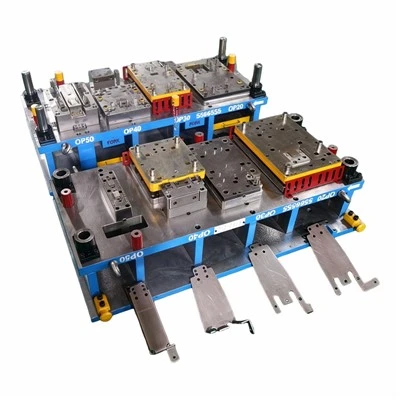
At the end of the day, gang die materials aren’t rocket science, but they require experience to get right. If you have questions about what material is best for your specific application, or if you’re looking to source a new gang die or single stage die, feel free to reach out to discuss your needs. I’m happy to walk through the options with you, no obligation.
Automotive & EV Stamping Parts References:
- Astakhov, V. P. (2006). Metallurgy of Die Steels for Metal Forming. CRC Press.
- Dieter, G. E. (1986). Mechanical Metallurgy (3rd ed.). McGraw-Hill.
- The Tool Steel Guide. (2022). Common Tool Steel Grades for Stamping Dies. Industrial Metal Supply.
- Tlusty, J. (2000). Manufacturing Processes and Equipment. Prentice Hall.
Dongguan Changdong Tool & Die Co., Ltd.
With abundant experience, we are one of the most reliable single stage dies & gang dies manufacturers and suppliers in China. Please feel free to buy advanced single stage dies & gang dies made in China here from our factory. Good service and quality products are available.
Address: No.56-B, Fumin South Road, Dalang Town, Dongguan City, Guangdong Province, China
E-mail: sales@cdstamping.com
WebSite: https://www.metalstampingdie.com/
